
Waiting to feel ready can become an indefinite postponement of ambition. For aspiring entrepreneurs, nearly every consequential decision is rooted in uncertainty: whether to pursue an idea, seek investment, bring a product to market, or expand a business. Requiring confidence before taking these steps allows hesitation to accumulate, increasing the perceived challenge behind taking action. From doubt arises the idea that experience is conditional on a certainty that can only be developed through experience itself. Consequently, a paradox arises: women often wait to feel confident before taking an action, while confidence is built through taking action. Carpe diem, the Latin message to ‘seize the day’, offers a response to this dilemma: taking initiative and seizing opportunities as they arise creates the grounds for confidence to grow.
For women navigating doubts about their entrepreneurial abilities, the relationship between action and confidence becomes even more troublesome. A 2025 Finnish study on entrepreneurial self-efficacy found that, albeit Finland ranks second globally in gender equality according to the World Economic Forum's Global Gender Gap Report, women still reported significantly lower entrepreneurial confidence than men. The study also identified a relationship between entrepreneurial experience and heightened confidence, suggesting that confidence is developed through participation. Fear of failure tends to discourage that fundamental participation. A 2019 study by the Wade Institute of Entrepreneurship found that female respondents frequently reported greater fear of failure, lower confidence in their entrepreneurial abilities, and less optimism than men. When anticipated failure becomes a justification for postponing action, hesitation sustains the uncertainty that produced it.
The contrasting response patterns between men and women identified in those studies concern how individuals respond to it. The Landmark Imposter Syndrome Research Study found that the rates between men and women struggling with imposter syndrome stood relatively similar with 49% of males and 52% of females reporting daily struggle. In the entrepreneurial world, the issue appears increasingly widespread: 86% of successful entrepreneurs in a Kajabi Study reported having experienced imposter syndrome, highlighting the prevalence of self-doubt in a field that requires individuals to act despite uncertainty. The Landmark study also identified differences in how men and women responded that doubt: men were more willing to apply for promotions when they met most of the requirements, while women were more inclined to wait until they felt ready or met every qualification.
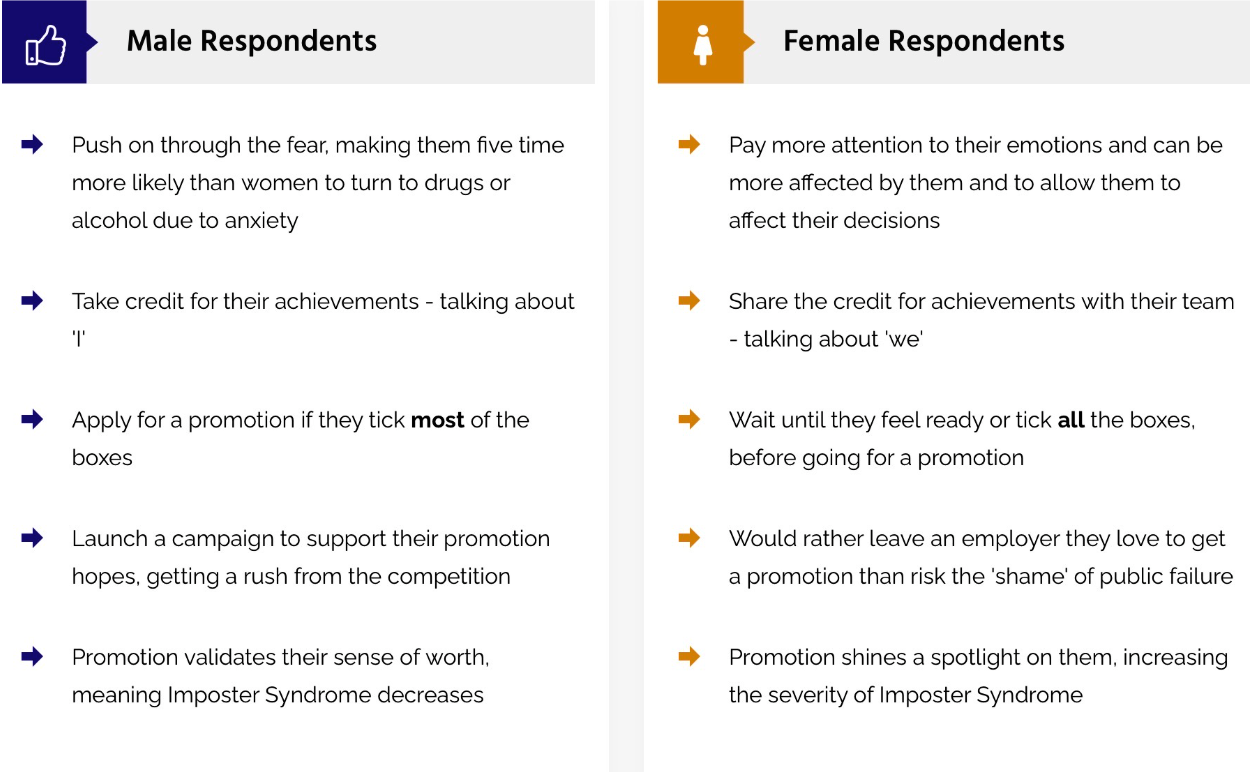
These contrasting responses to uncertainty can be understood through the distinction between avoidance-oriented and approach-oriented motivation. Avoidance-oriented motivation emphasizes preventing negative outcomes, such as rejection or failure, while approach-oriented motivation prioritizes pursuing desirable outcomes and growth. The responses described in the Landmark study suggest a greater tendency towards avoidance-oriented behaviors among women, potentially reflecting broader social expectations that encourage caution and perfectionism. In entrepreneurial settings, hesitation can mean passing up investment opportunities or launching businesses with less capital instead of taking strategic risks to scale a business and generate visibility. While caution provides temporary security, it risks causing stagnation for female-led start-ups.
Taking initiative offers a way to interrupt this pattern. Women who hesitate to take entrepreneurial risks have fewer opportunities to build mastery through experience, while those who ‘sieze the day’ generate opportunities to develop their abilities and gradually strengthen their confidence through resilience and experience. Pursuing an idea, seeking investment, bringing a product to market, or expanding a business all provide experience that preparation alone cannot offer. Therefore, initiative is one of the most essential components of entrepreneurial growth.
To take initiative, women must identify the root of their hesitation and take measured risks. Because entrepreneurship is built on experimentation, failure should not be interpreted as incompetence, but as a necessary roadblock on the pathway to success. Adopting this perspective allows entrepreneurs to recover from setbacks without internalizing failure as a reflection of personal worth. Resilience helps sustain entrepreneurial success, but it begins with taking the first step and remembering to ‘seize the day’.
