How Melanie Perkins Transformed A Blank Canvas Into Canva
BY SARIA DEEK
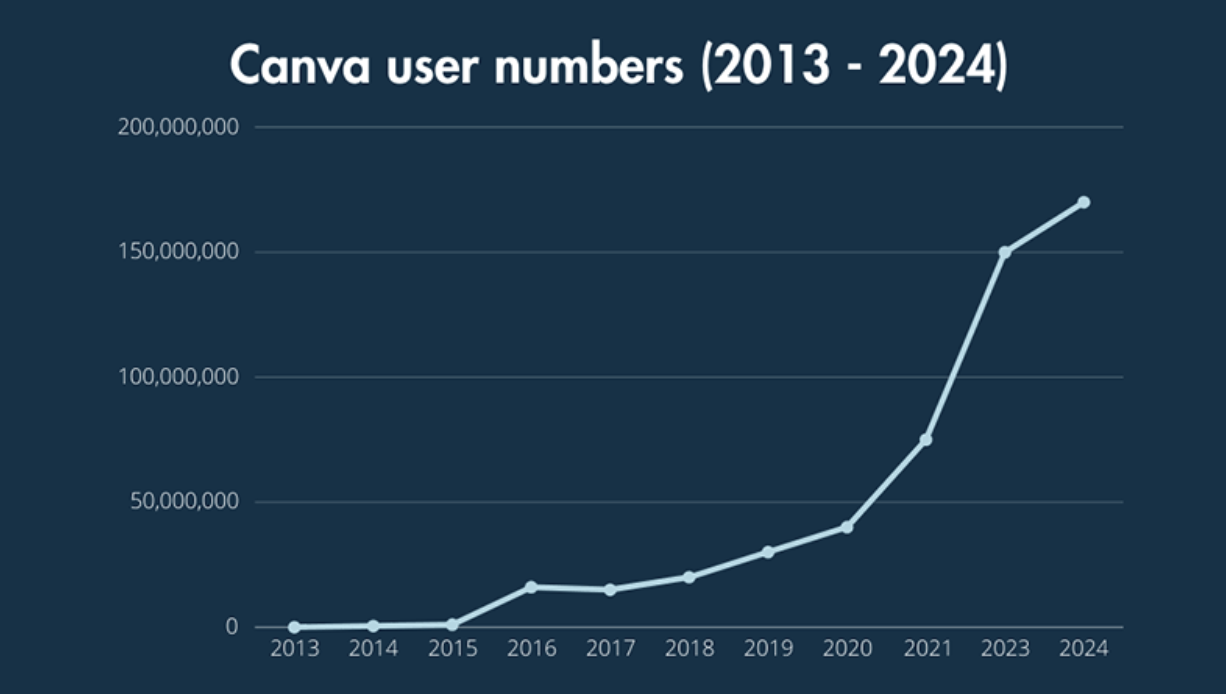
Ask a creative student pulling an all-nighter, a marketing intern scrambling before a pitch, or a club leader designing a last-minute flyer which website they open first, and chances are their answers will all be the same. With over 250 millions monthly users, it is no surprise that Canva has become the top design platform. What once required expensive software and hours of technical training can now be done in minutes, often for free. Its revolutionary drag-and-drop interface, endless customization, and polished templates make design accessible for almost any user. With over 85% of Fortune 500 companies relying on this software, it can be easy to get caught up in where this incredible software might be going. However, it is equally important to look to the past and ask yourself how this incredible platform came to be.
It’s all due to Melanie Perkins, an Australian entrepreneur who built this billion dollar enterprise out of her parents’ living room. In the early 2000’s, one of Perkins’ many side jobs was teaching students how to properly use popular design softwares. Though this may come as a surprise to us now, learning how to use these platforms was certainly not easy. Students could spend hours just trying to insert text into a photo on Microsoft or import a file on Adobe, and many found themselves giving up their creative dreams because of these difficulties. Perkins found this ridiculous. She recalls, “People would have to spend an entire semester learning where the buttons were, and that seemed completely ridiculous.”
The issue was not a lack of creativity or dedication, but the steep and unforgiving learning curve imposed by these traditional design softwares. So, in 2007, Perkins had enough of watching dreams fizzle in front of her very eyes. To her friends and family’s shock, Perkins dropped out of university and, with her boyfriend Cliff Obercht, set out to solve this. The determined duo launched Fusion Books out of an antique and stinky abandoned hair salon in Sydney, with limited resources and absolutely no experience. Fusion Books was founded with a deceptively simple concept: students could collaborate on an online platform and design their yearbooks, then the Australian couple would print and ship the finished copies back to schools.
The early days of Fusion Books were certainly not easy. Perkins spent her 18-hour work days calling school principals and pitching her services on the spot. The majority of these principals hung up on her before her second sentence. Those who listened were rare and often hung up unconvinced. On top of this stagnant growth, it is incredibly expensive to run a business. Simply put, Perkins and Obercht couldn’t afford going on this way for much longer. The couple would have instant noodles for breakfast, lunch, and dinner, and walk everywhere to save bus fares. Their website crashed more often than it worked, and late-night calls with irate teenagers who had lost weeks of work were more common than precious hours of sleep.
Despite these challenges, the company gained traction. Essentially a niche testing ground for Canva, Fusion Books became the largest yearbook supplier in all of Australia and still runs profitably today!
Even with this success, Perkins was unsatisfied. Her true dream, what she calls her “crazy, big dream,” was to create a universal design site available to everyone. Perkins believed design should not be exclusive or complicated, even for those with no design experience. Thus was born Canva.
Of course, bringing this dream to life was not as simple as believing in an idea. So, Perkins took a risky step. She looked further than anyone in her family had even before. All alone, Perkins traveled to Silicon Valley, the venture capital giant of the time. We all know how this ends, seeing as Canva is so successful today. But at the time, confidence in Canva was at rock bottom. Canva was rejected by 100 various investors, and making relationships in silicon valley with these investors seemed impossible as an outsider. Reflecting her perseverance and struggle, Perkins says “when you don’t have any connections, you don’t have any network, you just kind of have to wedge your foot in the door and wiggle it all the way through”
This hard work bore fruit. By the time Canva had closed their first funding round, the company was oversubscribed. In only 3 years, Canva accumulated over 2.5 million users and became a global phenomenon. Canva finally became a Unicorn in 2018 with their $40M investment round, the same year they also hit 1B designs.
Canva did not win by being the most advanced design software on the market. It succeeded by being the most usable. Perkins spent years pursuing her dream, one that hundreds of investors dismissed at the start. Today, those same skeptics point to Canva as one of the most valuable design platforms in the world. Perkins’ story teaches that true dedication to a passion might actually pay off in the end; so don’t give up that dream of yours.
