
Progress Isn’t Linear in STEM Education
BY ARIANA TAVOKKOLI
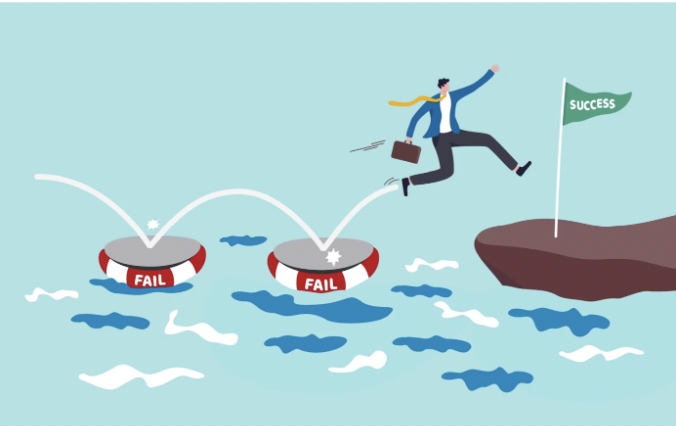
Many people view failure as something to avoid. Oftentimes students in STEM can put too much focus on getting the right answer the first time. In reality, progress is “an iterative cycle of doing, failing, and trying to do again but learning along the way.” Growth is not about perfection, but rather it’s about building resilience and the ability to adapt.
Natalia Jasper is a teacher of STEM subjects including math, physics, and engineering. She graduated as a mechanical engineer, earning her masters in mechanical engineering. She later went on to work for a company that focused on aerospace and air travel design and engineering. Throughout her time as an engineer she worked as a designer on parts for the Orion space craft. When speaking about her time as an engineer she highlighted the idea that progress in STEM moves at an extremely slow pace, and often it “can be difficult to see the end goal”. For example it “took about 10 years from the day” she started “till the day the ship was launched into space for a test run.”

Iberdrola
Ms. Jasper later transitioned to become a teacher, earning another masters in teaching, and joining Teach for America. She had “always been passionate about education”, and “as exciting as engineering was”, ultimately it wasn’t what she wanted to do. What she enjoys about teaching is that it’s “a fun challenge.” Ms. Jasper truly believes that “everybody has the potential to improve in any area.” She’s seen students that have struggled and worked hard to pull themselves up, noting that “teaching has really shined a light on what it means to be a learner.” Something that Ms. Jasper likes to emphasize, specifically in her engineering class, is “knowing and understanding when to start over versus when to keep going.”
Ms. Jasper recalled a time in her childhood, where she felt like she just wasn’t good at math. When she got to “prealgebra in 7th grade” she was failing “and it didn’t make any sense” to her. She ended up having to take a test over the summer, in order to pass her math class. From that experience of confusion followed by improvement, Ms. Jasper learned that “STEM is all about being able to deal with failure successfully." Moreover “just because you don’t do something right the first time, doesn’t mean you’re not good at it.” Ms. Jasper explains that “we live in a time where failure seems to be catastrophic” but as a teacher she tries to share her own experiences and relate to her students. Even now Ms. Jasper “makes mistakes everyday”, but those things simply happen “and you just do better next time.”
Hello Leaders
Throughout her time in STEM Ms. Jasper has observed that it can be hard “to trust your voice in academic or professional settings.” Especially “as a woman in STEM it’s even harder to trust yourself and your abilities, because oftentimes people look at you, and think: she can’t know this.” Ms. Jasper was “one of four women” in her graduating mechanical engineering class of 100. Every room she walked into she was one of one. She recalled instances where people thought she didn’t deserve her grades, and unspoken challenges “that chip away at your own confidence.” Ms. Jasper has experienced firsthand the difficulty of being counted out, simply because of gender. Something that has reassured her is “working with colleagues” who remind her of how capable she is.
Overall Ms. Jasper highlighted that if you’re not failing you’re doing something wrong. To this day she is “still learning” and “still has lots of doubts”, exemplifying that growth is a constant process and the best one can do is push through. Her advice is to “not give up, just keep going, you can do it.”
